

|
(Some of the english pages are under construction)
Related links published to related issues or statements to Hempstone:
http://www.nachwachsende-rohstoffe.biz/faserpflanzen/hanf/hempstone/

"Could be synthetic
- but it is a natural product."
Hempstone
is made from pure hempfibre
without any aditionals as glue or synthetic,
only colored with nontoxic colors.

Hannes Kelz,
all-round musician, sound
engineer and
inventor of the drum circle model Dramorama
(an audio visual animation method for mass drum performances)
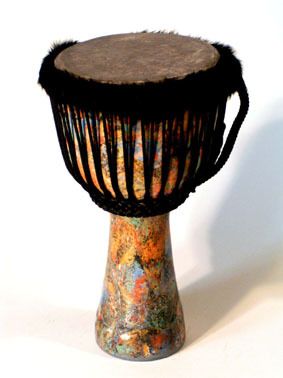
is really excited about these flipped out jembes:
"They bring life and color to the scene, they are really cool
and have a fat sound."
We make didgeridoos,
hemp drums
and the semiacoustic
guitar MADA caimes
in cooperation with guitarbuilder Andreas Neubauer
and designer Adam Wehsely-Swiczinsky.
www.madaguitars.com
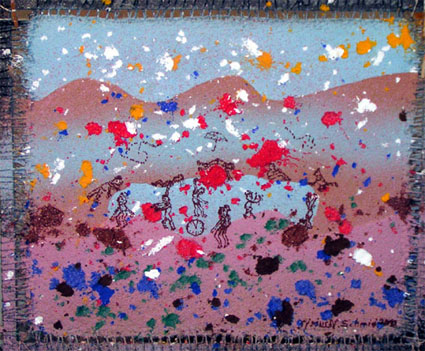
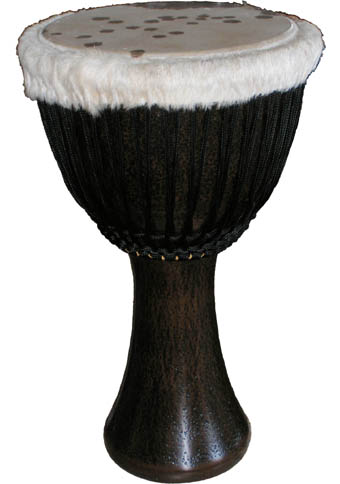
Gallery: Hempstone Jembes: As
Synthetic but still a natural product.
The first series is now available. Ask for prices on email or phone.
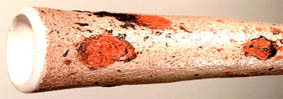
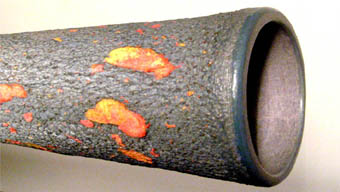
Click to Hempstone R didgeridoos
Why instruments
from Hempstone R ?
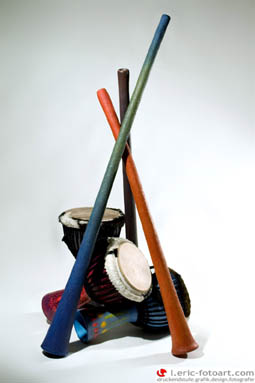
Jembes, Didgeridoos and other hempstone instruments-
the advantages:
Hempstone is an enormous
resistant material.
These drum bodies are do not rip, are strong and of an incomparable
performance.
Their design is multiple colorful and yet a natural product.
These
instruments are lighter in weight and are creatively brought into
shape and all that without a loss of sound.
The
acoustic form and measurement can be exactly constructed and can
be realized
to the demanded optimum.
Hempstone
proves to have incredible acoustic attributes.
Hempstone
Sound is changeable: wooden to metallic ceramic,
as you wish the material to be mixed.
Hempstone
is ideal for the construction of round and hollow bodies.
They are built in one piece in a monolithic way, but are still individually
cast in form and design.
If
you are looking for thorough and precious craftsmanship you are
here at the right spot.
Zelfo
is the universal description of the patented material;
Hempstone so to speak is Zelfo made of hemp fiber.
Hempstone is made from pure hempfibre
without any aditionals as glue or synthetic,
only colored with nontoxic colors.
Why ´we take hemp
fibre for producing Hempstone?
Hemp is a precious, frugal,
productive plant.
It is a very environment friendly and age old plant.
To cultivate it, you need neither Herbicides nor Pesticides.
Used since millenniums, the plant was demonized in the 1930s
under the false pretences of drug abuse, but mainly for economic
reasons.
Even the employment or the possession of other products of the plant,
such as its fiber or oil was punishable.
Such it is still today in many countries.
The history of the hemp plant is quite fascinating
and a great example
for political and economic propaganda and the errors of human culture.
Literature: A very complex and objective work is
the illustrated book "Cannabis" by
Mathias Broeker:
AT publishing house ISBN 3-85502-972-9.
Mathias Broeker was editor of the German TAZ and
wrote several works about hemp. He is considered one of EuropeÕs
hemp experts.
The abuse of the drug in our modern industrial
society is still the engine
to judge the plant as dangerous,
even though only a few of its family contain the drug Cannabinole,
which contains THC.
Since a few years some Industrial countries allow to plant some
species
with low THC content under supervision.
Hempstone: "You take fibrous plants (hemp,
straw, flax)
beat them to a mush and form whatever you please- i.e. the body
of a jembe"
( quote: Helmut Santler)
"Experience shows that Hempstone is made of
a hemp fiber mush".
(Quote: Erika Rihs-Nesweda)
"High energised molecules perform
strongly to one" (Quote: Erika Rihs-Nesweda)
"Cellulose material made of plant cells a universal
substance,
nutrient of the flora, which is the main source for food and energy
in the animal kingdom,
and therefore also the human world,
shows it´s long hidden potential,
when mixed in it´s smallest form with water with the help
of so called hydrogen bridge bond
and without other additivesd, then dried,
will make a solid raw material". (Norbert Schmid)
This part will be tranlated soon:
Tecnical features and history::
Der Zellulose- oder zellulosehältige, wässrige
Brei zieht bei Trocknung auf eine feste Form auf, auch ohne chemische
Zusätze oder Bindemittel, seine Eigenschaften sind variierend
von sehr leicht, holzartig, über hornähnlich, bis steinern,
daher Hempstone.
Chemisch-physikalisch wird der Bindevorgang im wesentlichen
durch die sogenannte Wasserstofbrückenbindung der Zellulose
und Hemizellulosen bewerkstelligt, das Wasser verschwindet beim
Trocknen und die Zellulosefasern binden sich so zueinander. Wie
weit dabei auch kovalente Vorgänge eine Rolle spielen, scheint
noch nicht voll erforscht zu sein.
Bezeichnungen wie z.B.: Zellfo beschreiben den gleichen
Vorgang. Der Name bezieht sich darauf, dass es sich um besondere
neu entdeckte Eigenschaften von Zellulose allgemein handelt.
Hempstone wurde in den 90-er Jahren von Robert Bramsteidl,
Horst Döpfner und Martin Ernegg erfunden, bzw. entdeckt. Zellform
Ges.m.b.H., dessen Geschäftsführer Dr. Stadlbauer von
Internorm war, hat Hempstone zur Patentreife gebracht. Internorm
zog sich später aus der Entwicklung zurück und Zellform
mußte nach versuchtem Ausgleich Insolvenz anmelden, da Forschungsförderungen
in Folge fällig gestellt wurden. In dieser Zeit haben wir Prototypen
von Trommeln in Zusammenarbeit gebaut und die hervorragenden Eigenschaften
des Werkstoffes Hempstone für unseren Bedarf kennen und nützen
gelernt. 2004 wurden die Patentrechte von Sarah Phillips und Richard
Hurding erworben und gesichert www.omodo.org.
Wir haben mit Ihnen einen Lizenzvertrag zur Herstelung von Musikinstrumenten,
Klang- und Kunstobjekten.
|